SHRM CP Situational Questions Effective Answer Strategies
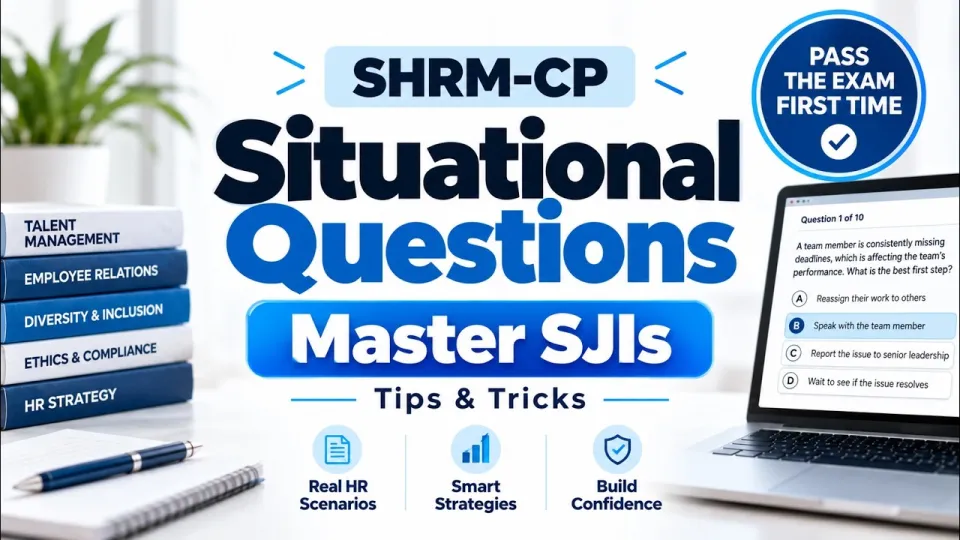
Video: SHRM CP Situational Questions (SJIs) | TIPS TO PICK THE RIGHT ANSWER
· based on the channel PrepSolution
SHRM CP Situational Questions require candidates to evaluate workplace scenarios and select the most appropriate HR response. These situational judgment items (SJIs) challenge test-takers by presenting multiple seemingly correct answers. The key to success lies in understanding how to pick the right answer by applying specific decision-making criteria and recognizing common answer traps. For those preparing for the SHRM CP exam, free SHRM CP practice questions and resources can enhance readiness and confidence.
Understanding SHRM CP Situational Questions
Situational questions simulate real HR issues where you must choose the best course of action. Unlike knowledge-based questions, these assess judgment and application of HR principles. The challenge arises because multiple options may appear reasonable, requiring careful analysis of the scenario and question wording.
The SHRM CP exam often tests the ability to discern whether the question asks for the initial or the most effective step. This distinction is crucial: some questions want you to identify the first action to take in a process, while others ask for the best overall solution to the problem.
Five Decision Checks for Choosing the Best Answer
A structured approach improves accuracy when answering situational questions. Consider these five decision checks:
- Facts: What does the scenario specifically state? Answers must align with the given information.
- Policy and Law: Does the option comply with organizational policies and legal requirements?
- Appropriate Escalation: Is the level of escalation suitable, or is it premature or unnecessary?
- HR’s Role: Is HR intervening appropriately without overstepping managerial responsibilities?
- People Involved: Are the right stakeholders included or informed in the decision?
Apply these checks systematically to eliminate answers that violate any of these criteria.
Common Answer Traps in SHRM CP Situational Judgment Questions
Many incorrect options fall into predictable traps. Recognizing these prevents selecting answers that seem appealing but are ultimately flawed.
- Premature Action: Acting before gathering all necessary information or before it’s appropriate.
- Passive Responses: Avoiding action or delaying needed intervention.
- Taking Over Manager’s Responsibilities: HR should support, not replace, supervisors.
- Unnecessary Escalation: Escalating issues unnecessarily can complicate or worsen situations.
- Legally Defective Options: Choices that could lead to legal violations or noncompliance.
When reviewing answer options, watch for these traps to narrow down the correct response.
Practical Tips for Eliminating Wrong Answers
Avoid relying solely on personal workplace experience since practices vary. Instead, test each answer against the scenario’s facts and specific wording. Ask:
- Does this option violate any policies or laws?
- Is this the next logical step or the best overall solution?
- Does this response respect HR’s role boundaries?
- Is escalation justified here?
By answering these questions, you can systematically exclude weaker options and identify the best fit.
Applying These Strategies: A Sample Scenario
Consider a situation where a supervisor wants to discipline an employee after a shouting match. The question asks for HR’s next step. Using the five decision checks, you would:
- Review the facts: Confirm details of the incident.
- Check policy: Understand disciplinary procedures.
- Evaluate escalation: Decide if HR should intervene now or advise the manager.
- Clarify HR’s role: Support the manager rather than taking over.
- Identify stakeholders: Include the employee and supervisor appropriately.
Assessing all four answer choices in this way reveals which is premature, passive, overreaching, or legally unsound, guiding you to the best answer.
Useful Links
Summary
Mastering SHRM CP situational questions requires a clear strategy to differentiate between similar answer options. Focus on whether the question asks for the first step or the most effective solution. Use the five decision checks—facts, policy and law, escalation, HR role, and involved parties—to evaluate each answer. Watch out for common traps like premature action or unnecessary escalation. Practicing with real scenarios and official resources like those from PrepSolution will boost your confidence and exam performance. For continued practice and detailed explanations, explore PrepSolution’s materials and free question sets linked above.
Key takeaways
- SHRM CP situational questions focus on HR scenarios requiring judgment.
- Key decision checks include facts, policy, escalation, HR role, and involvement.
- Recognize traps like premature action and unnecessary escalation.
- Distinguish between first step and most effective response.
- Practice elimination by aligning answers with scenario details.
Questions & answers
What are SHRM CP situational judgment questions?
They are exam questions presenting HR scenarios where candidates must choose the most appropriate response based on judgment and HR principles.
How can I determine the best answer in SHRM CP situational questions?
Use the five decision checks: align with facts, comply with policies and laws, ensure proper escalation, respect HR’s role, and involve the right people.
What are common traps to avoid in these questions?
Avoid answers that involve premature action, passive responses, taking over managerial duties, unnecessary escalation, or legal noncompliance.
Where can I find free SHRM CP practice questions?
You can access free practice questions and study resources at PrepSolution’s site: https://prepsolution.com/free-practice/shrm-cp?utm_source=youtube&utm_medium=video&utm_campaign=shrmcp_longform&utm_content=cp_long_v09
Source: SHRM CP Situational Questions (SJIs) | TIPS TO PICK THE RIGHT ANSWER · Markdown version